Concept
A model neighborhood
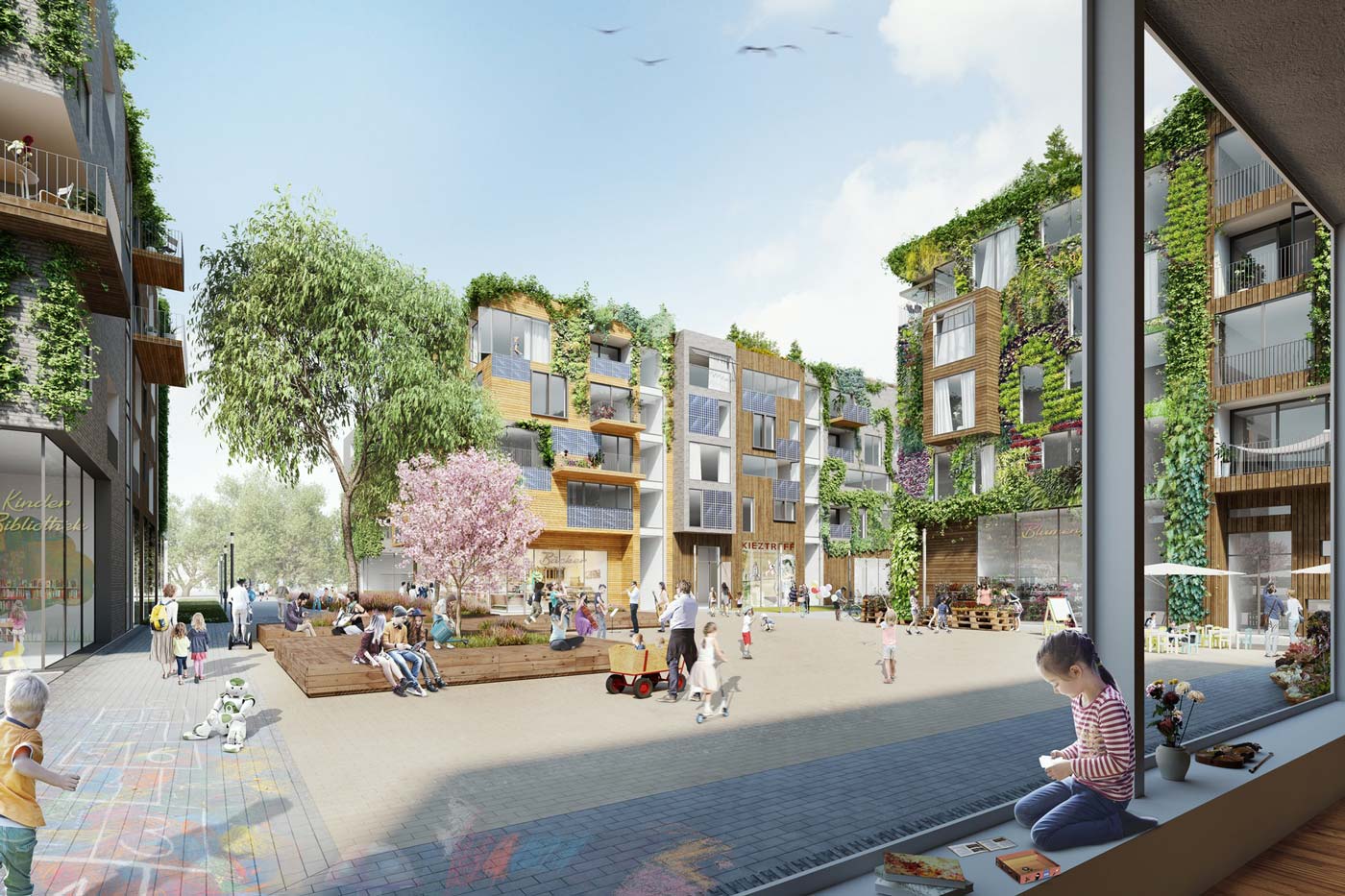
Designed with social responsibility and sustainability in mind – the Schumacher Quarter focuses on concrete measures in construction, energy, and mobility, making it a model neighborhood for urban development in Berlin.
©Berlin TXL Management GmbH/ rendertaxi
More than 5,000 new apartments are being built in the Schumacher Quartier to house more than 10,000 people, along with the necessary shopping facilities and public amenities. Plans call for an educational campus with two schools, as well as sports and youth facilities, and six daycare centers.
The best part is: All of this is available to everyone. That’s because the Schumacher Quartier combines different types of buildings and uses.
Made for tomorrow
Thinking about tomorrow today: In the Schumacher Quartier, renewable raw materials such as wood and low-emission recycled materials are used. Heating and cooling systems consistently focused on renewable energy, rainwater harvesting based on the “sponge city” principle, low-emission mobility, and measures to promote biodiversity have been part of the concept from the very beginning. The result is a neighborhood designed to achieve low-emission and climate-resilient development.
Good for the climate, good for everyone
What’s good for the climate is also good for people: less traffic, cleaner air, lower energy costs, and about 30 hectares of public green spaces, playgrounds, and city squares.
Learn more about our conceptual elements:
Urban timber construction
Water use
Mobility
Biodiversity
Energy
Various districts are being built on the five square kilometer Berlin TXL site:
Schumacher Quartier
To the east of the former airport site and extending slightly beyond it, the 46-hectare Schumacher Quartier is taking shape. This new residential neighborhood will offer over 5,000 apartments for more than 10,000 people along with the necessary amenities such as schools, daycare centers, sports facilities, shopping options, and plenty of green space.
As a socially diverse neighborhood, the Schumacher Quartier will make an important contribution to the German capital’s housing and urban development strategy. In a charter, all participating partners have agreed on seven guiding principles for the development of the Schumacher Quartier:
- Urban living spaces
- Housing for all
- Urban greenery and public space
- Open educational landscape
- Climate-friendly and water-sensitive urban development
- Neighborhood with environmentally friendly mobility guarantee
- Communication, participation and transparency
Urban Tech Republic
The Urban Tech Republic, a research and industrial park where technologies for the city of tomorrow are researched, developed, produced, tested and exported, is being created from the airport buildings and the adjacent areas. This is where science and research meet industry and commerce and start-ups meet investors. And everyone is working together on solutions for the sustainable and resilient cities of tomorrow.
Six core themes of urban technologies were defined for the curated location:
- climate-neutral energy systems and the efficient use of energy
- Environmentally friendly mobility
- Clean Water
- Recycling
- The use of new materials for applications such as sustainable construction
- The networked control of systems
The existing buildings have a gross floor area of around 200,000 m². The campus will cover 39 hectares, the commercial strip 70 hectares and the industrial park 82 hectares. The total area of the Urban Tech Republic covers 202 hectares.
Users of the Urban Tech Republic will include start-ups, students, academics and established companies. Two important anchor users have already been confirmed: the Berlin University of Applied Sciences and the Berlin Fire and Rescue Academy (BFRA).
Several dozen companies are already on site and are using rental space in the former airport buildings and experimental areas on the former airfield. Up to 1,000 companies can settle here in the future; up to 20,000 jobs are expected to be created.
Tegeler Stadtheide
On the site where airplanes once took off, Grün Berlin will develop and operate a unique leisure and recreation area for Berlin in the coming years. The Senate Department for the Environment, Transportation, and Climate Protection has entrusted Grün Berlin with the task of implementing the necessary development and conservation measures for the Tegeler Stadtheide landscape.
The 190-hectare site encompasses the protected transitional zone between the new urban districts to the south and east of the former airport grounds and the existing landscape conservation areas of Flughafensee and Jungfernheide to the north and west. The goal is to create an open space that brings together nature, life, and work in a high-quality and sustainable way.
On the contrary: traffic will tend to decrease and the surrounding area will be relieved. For comparison: before the collapse in air traffic as a result of the coronavirus crisis, more than 70,000 people traveled to the airport every day – via the bottleneck of the airport feeder road. In the future, up to 20,000 people will work in the area and around 10,000 people will live there. An innovative mobility concept has also been developed for Berlin TXL.
Not in the short term. The site was closed when air traffic ceased. However, our Infocenter Berlin TXL in Building V is available for you to obtain information, visit exhibitions or take part in events, and you can also book the premises for your event.
To ensure that many people can enjoy this special place, guided tours of the grounds take place regularly. The two-hour outdoor walks can be booked at https://museumsdienst.berlin. Individual existing areas are also used for events.
Outside of these offers, the area is inaccessible and secured against unauthorized access. As soon as the respective construction phases are completed, the site will gradually become accessible to the public.
Grün Berlin GmbH is responsible for the expansive landscape area north and west of the Urban Tech Republic. Several new access points will also be created there in the future. Currently, the Stadt Natur campus already offers a number of guided tours and events on-site at the Tegeler Stadtheide.
Quite a lot. Apart from the huge landscaped area, which will be freely accessible, there will be a variety of attractive sports and exercise facilities: Playgrounds, multi-sports facilities and fitness and health points along running routes. A roller derby track, a street skate facility, a streetball facility, a bicycle course, a parcours and calisthenics facility and much more will be offered on the runway and taxiway surface. A bouldering facility, a grass ball sports area, an area for frisbee golf and an outdoor fitness area are planned for the park’s green spaces.
All sports and play areas in the neighborhood and landscape park will be designed with gender requirements in mind and as barrier-free as possible to support joint play. Shade roofs and seating, picnic tables and informal stands will be arranged in the sports and play areas to create a variety of meeting points.
Downloads on the topic
Schumacher Quartier – The Charter
With its principles and guidelines, the Schumacher Quartier Charter forms the basis for forward-looking neighborhood development. (Only available in German)
Quarter book part A
The neighborhood book summarizes which visions and concepts are to shape spaces and design in the new urban neighborhood. It is an introduction and guide so that the neighborhood can gradually take shape. Part A describes and records the key issues of the neighborhood. (Only available in German).
Quarter book part B
Part B formulates the design framework for the development of the neighborhood, acting as a “guide” and defining both rules and site-specific specifications for implementation. (Only available in German)
Urban development framework plan
Here you can find the urban development framework plan of the Schumacher Quartier.